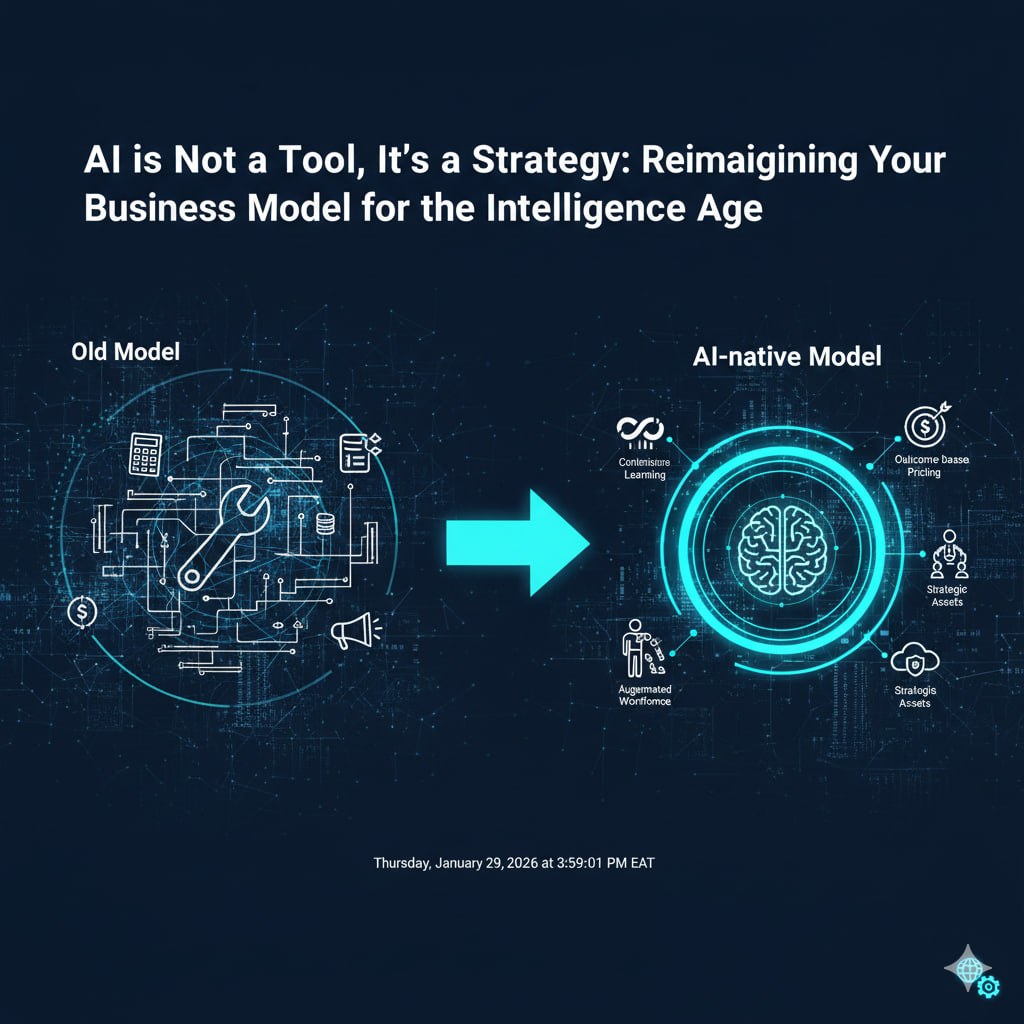
In the early days of personal computing, owning a word processor was a tool; digitizing your entire document workflow was a strategy. Similarly, in 2026, many businesses view Artificial Intelligence as a mere efficiency tool—something to automate customer service or generate marketing copy. But this perspective fundamentally misses the point.
AI is not just a tool; it’s a foundational strategic imperative. To truly thrive in the Intelligence Age, businesses must stop asking, “How can we use AI?” and start asking, “How does AI force us to reimagine our entire business model?”
This isn’t about incremental improvements; it’s about a fundamental shift in how value is created, delivered, and captured.
The Shift from “Optimization” to “Transformation”
For the past few years, AI implementations have largely focused on optimization:
- Customer Service: AI chatbots handle FAQs.
- Marketing: AI generates ad copy variations.
- Operations: AI streamlines supply chain logistics.
While valuable, these are tactical applications. A strategic view of AI challenges the core assumptions of your business:
1. From Product-Centric to “Intelligence-Centric” Offerings
- Old Model: You sell a product (e.g., a software platform, physical device).
- AI-Native Model: You sell intelligence embedded within or derived from your product. The product becomes a data capture and delivery mechanism for the core AI service.
- Example: A fitness tracker is a product. An AI-powered personal health coach that continuously optimizes workouts, sleep, and nutrition based on biometric data, and evolves with you, is an intelligence-centric offering.
2. Redefining Value Creation: Where is the “Moat”?
- Old Model: Value derived from proprietary hardware, intellectual property, or traditional network effects.
- AI-Native Model: Value is created through proprietary data + superior algorithms + continuous learning loops. Your competitive moat is your ability to accumulate unique data and train AI models that outperform competitors.
- Example: A traditional bank sells financial products. An AI-native financial advisor uses vast, anonymized transaction data to predict market shifts, personalize investment advice at scale, and even anticipate customer needs before they arise, offering unparalleled value.
3. New Revenue Models: From Subscriptions to “Outcome-Based” Pricing
- Old Model: Selling licenses, subscriptions, or one-off products.
- AI-Native Model: AI enables entirely new pricing structures. If your AI guarantees a specific outcome (e.g., “reduce energy consumption by 15%,” “increase sales conversions by 5%”), you can move to outcome-based pricing, taking a share of the value created.
- Example: Instead of selling a marketing automation platform (subscription), an AI-driven growth agency charges a percentage of the additional revenue their AI generates for clients.
4. The Augmented Workforce: Humans and AI as a Seamless Unit
- Old Model: AI replaces human tasks.
- AI-Native Model: AI augments human capabilities, allowing teams to operate at a superhuman level. It’s about synergy, not substitution.
- Example: Instead of replacing customer service agents, AI agents handle routine inquiries and distill complex problems into actionable summaries, empowering human agents to focus on high-value, empathetic interactions.
5. Strategic Data as Your Most Valuable Asset
- Old Model: Data is a byproduct, often siloed and underutilized.
- AI-Native Model: Data is a strategic asset, consciously collected, structured, and leveraged to fuel AI models. Data strategy becomes central to business strategy.
- Example: A manufacturing company moves from collecting basic sensor data to implementing a comprehensive “digital twin” strategy, where AI continuously simulates and optimizes production, predicts failures, and designs new products based on real-time feedback loops.
Building Your AI-Native Business Model: A Strategic Imperative
To make this shift, businesses must:
- Conduct an AI Readiness Audit: Assess your current data infrastructure, talent, and existing AI capabilities.
- Identify “AI-First” Value Propositions: Where can AI fundamentally transform how you deliver value to customers, not just optimize existing processes?
- Invest in Data Strategy: Prioritize data collection, cleaning, and structuring. Your AI’s intelligence is only as good as your data.
- Foster an AI-Literate Culture: Train your workforce. Everyone, from sales to product development, needs to understand AI’s potential and limitations.
- Start Small, Think Big: Experiment with AI in core areas, learn quickly, and be prepared to iterate and scale transformational initiatives.
The companies that succeed in the Intelligence Age will be those that view AI not as a feature to be added, but as the operating system for their entire enterprise. It’s time to stop tweaking your existing model and start building the AI-native business of tomorrow.
Leave a Reply